

The Menopause Nutrition Toolbox
Why is everyone talking about gut health?
If you’ve spent any time looking for advice about managing menopausal symptoms, you’ll probably have noticed that gut health is suddenly everywhere.
Probiotics. Prebiotics. Fermented foods. Fibre. Soy. Phytoestrogens. Supplements.
And for every article telling you that one particular food is the answer, there seems to be another telling you to avoid it.
It can be exhausting.
Especially when you’re already trying to navigate a body that feels different from the one you knew a few years ago. Perhaps you’re not sleeping as well, feeling more tired, noticing changes in your weight or digestion, or simply wondering why things that once felt straightforward suddenly seem rather more complicated.
And then someone tells you that you need to “fix your gut”.
Where on earth do you start?
The good news is that you probably don’t need another complicated diet, an expensive collection of supplements or a complete overhaul of the way you eat.
What you might benefit from is understanding a little more about what’s happening inside your body—and how some simple nutritional choices may help support it.
Because your gut is doing much more than digesting your food. And during and after menopause, it may be part of a particularly interesting conversation.
So, what does this mean for you?
Nutrition can be an emotional subject. Food is personal. It’s part of our routines, our families, our cultures and our pleasures. Many of us have also spent years being told what we should and shouldn’t eat.
So this isn’t going to be another list of rules. My aim is to help you understand what the emerging science is telling us about the relationship between the gut, oestrogen and nutrition, and then turn that information into a few simple things you might choose to add to the way you already eat.
You don’t need to do everything. You don’t need to do it perfectly.
Understanding gives you choices. And choices give you the opportunity to find what works for you.
What does my gut have to do with menopause?
If you’re wondering what your gut could possibly have to do with menopause, you’re certainly not alone.
At first glance, the two don’t seem to have much in common. One is the place where your food is digested; the other is a stage of life associated with changing hormones.
But your gut is much more than a digestive system.
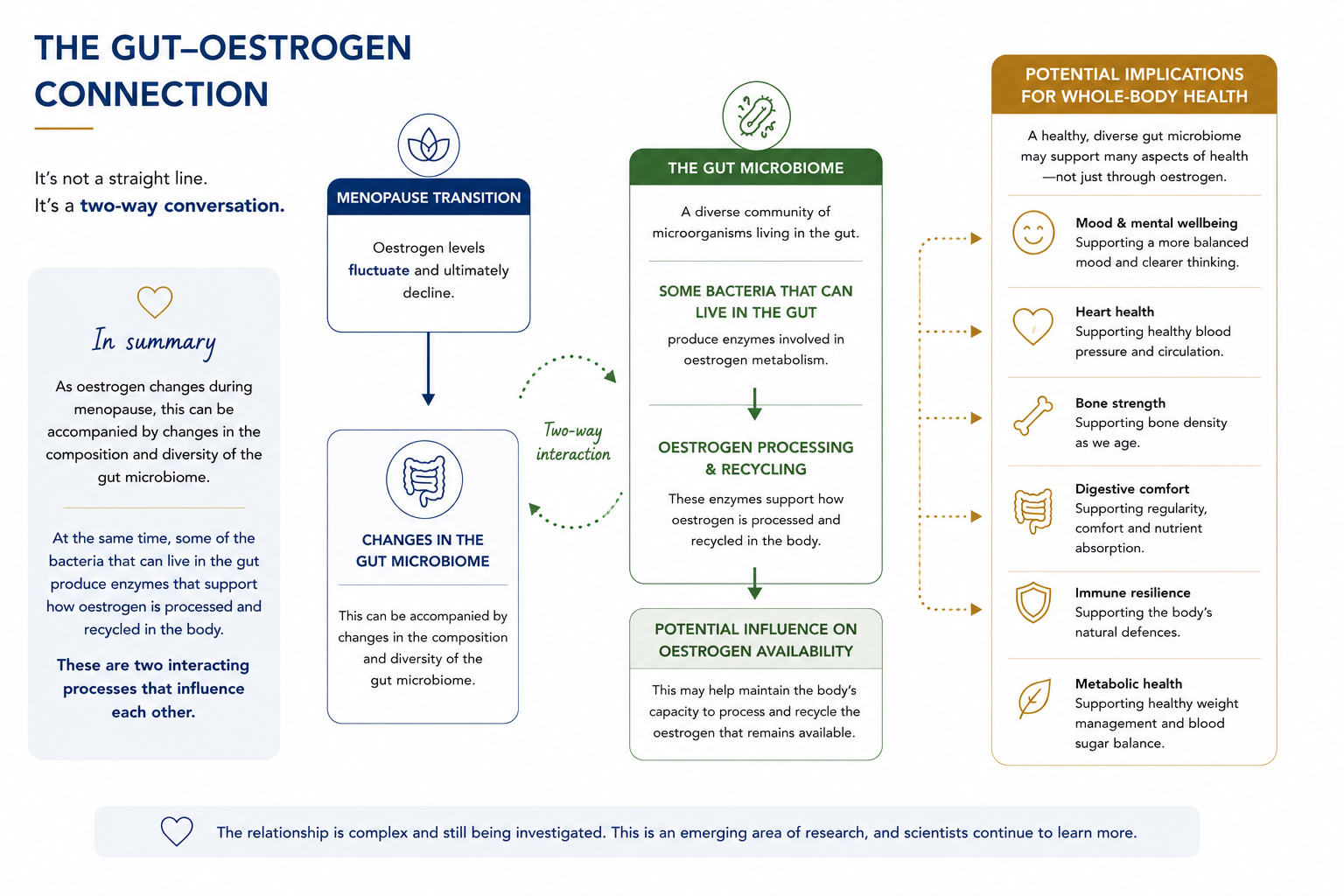
Inside it lives a vast community of microorganisms—the gut microbiome—that interacts with many aspects of our health. And one of the relationships researchers are increasingly interested in is the two-way communication between the gut microbiome and oestrogen.
As oestrogen levels fluctuate and ultimately decline during the menopause transition, this can be accompanied by changes in the composition and diversity of the gut microbiome. The relationship also works in the other direction: some of the bacteria that can live in the gut produce enzymes involved in the processing and recycling of oestrogen in the body. This is a relationship that exists throughout life, but may become particularly relevant during and after menopause, when supporting the gut microbiome may help maintain the body’s capacity to process and recycle the oestrogen that remains available.
In other words, it’s a conversation. Oestrogen can influence the gut microbiome. The gut microbiome can influence how oestrogen is metabolised.
This is sometimes described as the gut–oestrogen axis. And within the gut microbiome is a group of bacterial genes collectively known as the estrobolome, which can influence the metabolism of oestrogens and their circulation in the body.
Remembering the word estrobolome isn’t important. What matters is the bigger idea; that your gut and your hormones don’t operate independently, they’re part of a much bigger, interconnected system.
So, does this mean that changing your gut microbiome will “balance your hormones”?
Not quite.
This is where it’s worth being careful with some of the claims you may come across online. We know that the gut microbiome and oestrogen interact, and researchers are exploring what this might mean for women’s health during and after menopause. But we don’t yet have a simple formula that says:
change your gut bacteria → increase your oestrogen → resolve your symptoms.
The science is more interesting—and more nuanced—than that.
Can the food we eat really have an influence?
It’s a fair question, and it’s one we need to answer honestly.
The short answer is: potentially, yes.
The foods we eat feed the bacteria in our gut, and this can influence the composition and diversity of our microbiome. Some foods also contain plant compounds that can interact with oestrogen receptors in the body.
Research suggests these nutritional factors may help create a gut environment that supports the processing and recycling of oestrogen. However, it’s important to keep things in perspective.
This isn’t about a quick fix or a magic food. And we don’t yet have strong enough evidence to say that any one food or supplement will increase oestrogen levels or resolve menopausal symptoms.
What we do know is this. The foods we choose can influence the environment in which our gut bacteria live. And a healthier, more diverse gut microbiome may support overall health in many ways.
And that’s where our nutrition toolbox comes in.
The Nutrition Toolbox
There are three nutritional tools that are particularly interesting when we think about the relationship between food, the gut microbiome and oestrogen: prebiotics, probiotics and phytoestrogens.
They work in different ways, but they share something important: they can be incorporated into an ordinary, varied diet without requiring you to follow a special “menopause diet”.
🌱Prebiotics: feeding your gut
Prebiotics are types of dietary fibre and other compounds that aren’t fully digested by us but can be used as food by beneficial bacteria in the gut.
In simple terms, prebiotics help feed the community of microorganisms already living in your gut.
You can find prebiotic fibres in many everyday plant foods including onions, garlic, leeks, asparagus, bananas, legumes, whole grains and some nuts and seeds.
And this is one reason that plant variety matters. Different types of plant foods provide different types of fibre and other compounds for our gut microbes to use. Rather than looking for one “superfood”, eating a wide variety of plant foods may help support a more diverse gut microbiome.
A simple way to think about it: the more variety you give your gut microbes, the more variety they have to work with.
And you don’t need to transform your diet overnight. Adding another vegetable, choosing whole grains more often, or including beans or lentils in a meal are all steps in the right direction.
🥣Probiotics: adding beneficial microorganisms
Probiotics are live microorganisms that, when consumed in adequate amounts, can provide a health benefit.
Some fermented foods contain live microorganisms, including yoghurt, kefir, kimchi, sauerkraut and certain fermented soy foods. But there’s an important distinction here. Not every fermented food is necessarily a probiotic food, and not every probiotic product has the same effect.
The evidence around probiotics and menopause is still developing. Some studies suggest potential benefits for metabolic and bone health, but findings are not yet consistent enough to recommend a particular probiotic supplement for every woman.
So rather than taking a probiotic supplement, it may be more useful to think about making the fermented foods you enjoy something you eat regularly.
🌿Phytoestrogens: plant compounds with an interesting relationship with oestrogen
Phytoestrogens are naturally occurring plant compounds that have a chemical structure that allows them to interact with oestrogen receptors in the body.
This doesn’t mean that they simply “replace” oestrogen. Their effects are considerably more nuanced. Some phytoestrogens can bind to oestrogen receptors and, depending on the tissue and the circumstances, may have weak oestrogen-like or anti-oestrogen effects.
One group of phytonutrients that has attracted interest in relation to menopausal health is isoflavones, found especially in soy foods such as tofu, tempeh, edamame and soy milk. Flaxseed is another food rich in phytoestrogenic compounds called lignans.
There is some evidence suggesting that regular consumption of whole soy foods may modestly reduce vasomotor symptoms such as hot flushes, while also potentially contributing to cardiovascular and bone health.
A toolbox, not a checklist
We’re not looking for a magic food. We’re looking at what happens when these foods become part of an overall dietary pattern.
Think of these three tools as different ways you can support your gut health. You can choose one, combine a couple, or use all three — whatever works for you.
The individual foods matter, but the pattern matters more.
So where do I start?
There is no single “best” way to support your gut microbiome. Instead, think of the suggestions below as options to explore. You might already be doing some of them. You might find that one or two feel particularly easy to introduce.
The aim isn’t perfection. It’s consistency.
1. Add more variety to your plate
Your gut microbes thrive on the different fibres and plant compounds found in a wide range of plant foods. So rather than focusing on one particular “superfood”, try increasing the variety of plants you eat across the week.
Vegetables, fruit, whole grains, beans, lentils, nuts and seeds all count.
It could be as simple as putting one more vegetable on the menu for dinner, making oats part of your breakfast, or snacking on roasted chickpeas.
2. Give your gut something to feed on
Prebiotic fibres provide food for beneficial gut bacteria. You don’t need to seek out specialist ingredients: many of the foods you may already have in your kitchen are good sources, including onions, garlic, leeks, asparagus, oats, bananas and legumes.
Add some beans to a soup. Stir lentils into a curry. Add flaxseeds or chia seeds to your smoothie or sprinkle them on your oats. Roast onion and garlic with your favourite veggies. Small additions can be surprisingly easy.
3. Include fermented foods you enjoy
Fermented foods can introduce live microorganisms into your diet. Options include live yoghurt, kefir, kimchi, sauerkraut and miso.
You don’t need to eat fermented foods at every meal—or even every day. Perhaps yoghurt becomes part of breakfast. Maybe kefir is the base for a creamy salad dressing. Or you add a little sauerkraut or kimchi alongside an existing meal.
And remember: fermented doesn’t automatically mean probiotic. The two terms describe different things. Some fermented foods contain live microorganisms, but they don’t necessarily meet the scientific definition of a probiotic. Fermentation itself can also change the food, influencing its taste, digestibility and nutritional properties.
So you don’t need to choose between “fermented” and “probiotic”. Consuming fermented foods can be one way of adding variety to your diet, while probiotic supplements are a separate option with more specific, strain-dependent evidence behind them.
For most of us, this is another reason to start with food rather than feeling that we need to buy a cupboard full of supplements.
4. Explore phytoestrogen-rich foods
Phytoestrogens occur naturally in a number of plant foods. Soy foods such as tofu, tempeh and edamame, together with foods such as flaxseed and sesame seeds, can be easy additions to everyday meals.
If soy isn’t something you currently eat, you don’t need to make a dramatic change. Try edamame in a salad, tofu in a stir-fry or a soy-based yoghurt or milk.
Find what works for you
You don’t need to introduce four new habits this week – choose one.
If it works for you, keep doing it. Then, when it feels like part of your normal routine, add another tool to your box.
The best nutritional strategy is one that can become part of your life — one that fits your routines, your preferences, your budget and the way you already eat.
The potential value of these foods doesn’t come from eating them once or completing a three-week challenge. It comes from creating a dietary pattern that is varied, enjoyable and sustainable enough to continue over time.
And perhaps that is a much more useful way to think about nutrition during and after menopause:
Not “What do I need to eliminate?” but “What could I add?”
The bigger picture
The foods we eat are important, but they are only one part of the bigger picture of health during and after menopause.
Your gut microbiome doesn’t exist in isolation, and neither does your diet. Movement, sleep, stress, nutrition and medical care all interact with one another, and supporting one area can make it easier to support another.
Your health is shaped over time by the many choices, habits and circumstances that come together to support the life you want to live.
And perhaps that is the most useful thing to take away from this conversation about gut health and menopause:
You can choose the things that support your health and work for you — and let them become part of the way you care for yourself.
Healthy ageing isn’t about getting everything right. It’s about giving yourself the support, over time, to keep doing the things that matter to you.
Move with care. Nourish with intention. Give your body what it needs to keep taking you where you want to go.
Postscript
If you are interested in reading a little more of the science, please follow the link to the assignment submitted as part of my Pilates Mat Instructor assessment.


